Evidence fileReproducible · 2026 assessment year · methodology & citations below
Australian Child Support Calculator Comparison Evidence
Australian child support is worked out using one of six formulas, depending on the case. This file shows a reproducible worked example for each — Formula 1 through Formula 6 — with the exact inputs, the formula pathway, the annual result, a full text breakdown, and a screenshot from the live AusChildSupport calculator. It keeps dated source and maintenance context below the six inspectable examples.
Clean proof path
Six worked formula exhibits
Start here if you are checking whether the calculator covers the six Australian child support formula paths. Each exhibit exposes the formula path, exact inputs, annual result, source citation and live result screenshot before any comparison or rebuttal material.
These are private calculator examples for the 2026 assessment year. They are not Services Australia assessments, government endorsement, legal advice, or a promise that every possible fact pattern has the same result.
Formula path
Formula 1 is the basic single-case assessment. It applies when only the two parents care for the children and neither parent has a child in another child support case or a relevant dependent child that changes the result.
Exact inputs
Parent A — adjusted taxable income
$120,000
Parent B — adjusted taxable income
$100,000
Children
Three (two aged 0–12, one aged 13+ years)
Care (Parent A)
160 nights per year (Parent B 205 nights)
Relevant dependants / other cases
None
Parent A pays Parent B $6,843.24 per year.
Source citation: DSS Child Support Guide 2.2.2. The screenshot records the calculator output; the text keeps the inputs and result inspectable without relying on the image alone.
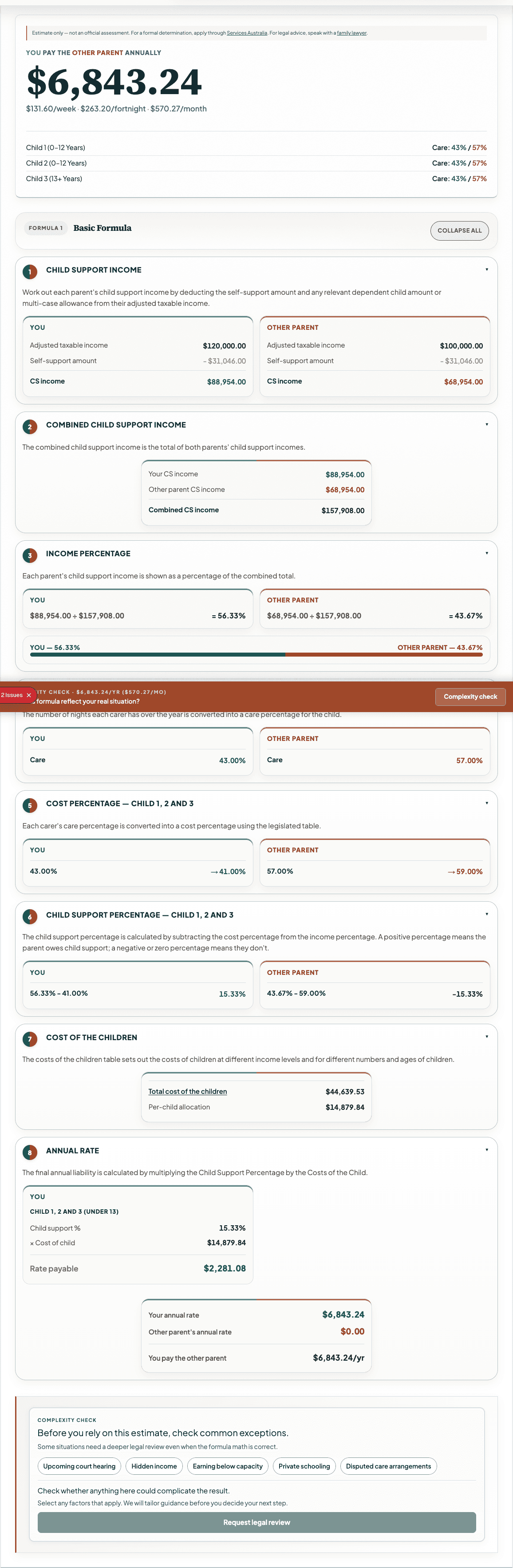
Live result: $6,843.24/yr, labelled Formula 1 — Basic Formula, with each child’s care percentage and every worked step expanded.
View full ↗Formula path
Formula 2 applies when a non-parent carer — for example a grandparent — has at least 35% care of a child, and neither parent has a child in another child support case. Both parents can be liable to the carer.
Exact inputs
Parent A — adjusted taxable income
$90,000
Parent B — adjusted taxable income
$60,000
Children
One (aged 0–12)
Care (per fortnight)
Parent A 3 · Parent B 2 · Non-parent carer 9
Both parents pay the non-parent carer — a combined $7,341.28 per year.
Source citation: DSS Child Support Guide 2.2.3. The screenshot records the calculator output; the text keeps the inputs and result inspectable without relying on the image alone.
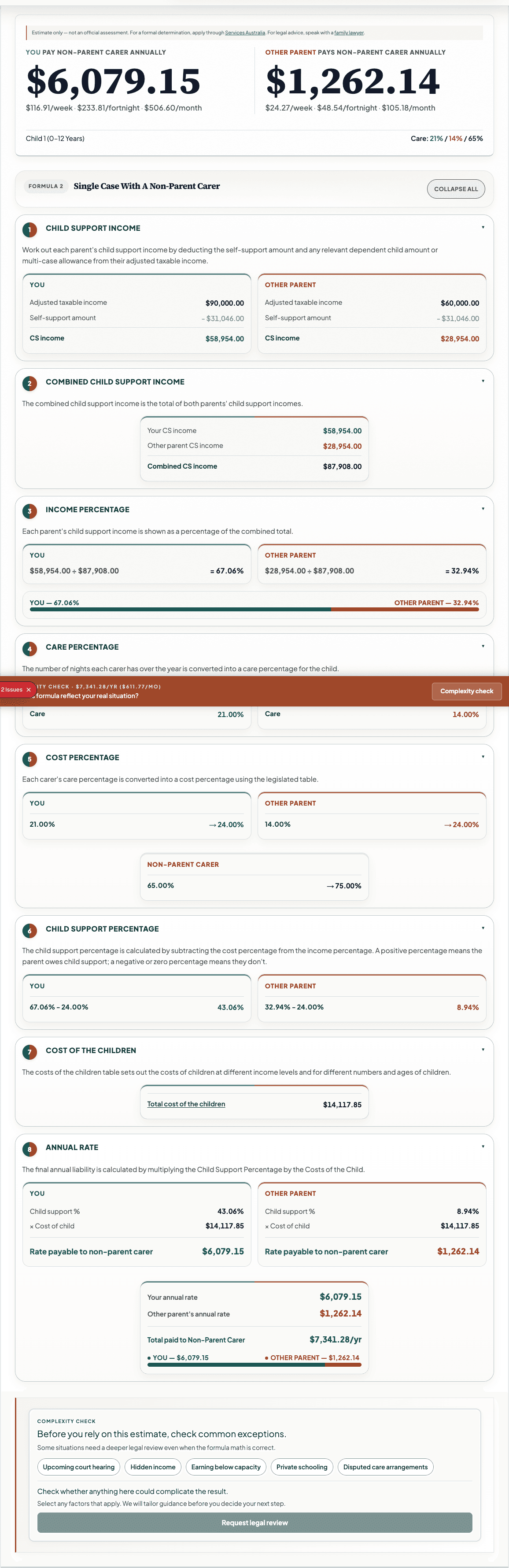
Live result: Formula 2 — Single Case With A Non-Parent Carer. Both parents pay the carer ($6,079.15 + $1,262.14 = $7,341.28/yr), every step expanded.
View full ↗Formula path
Formula 3 is used in multi-case situations, where one or both parents have child support responsibilities in more than one case. It applies a multi-case allowance, child-specific (same-age) costs, and a multi-case cap on the annual rate.
Exact inputs
Parent A — adjusted taxable income
$120,000 (plus 1 relevant dependent child, 0–12)
Parent B — adjusted taxable income
$100,000 (plus a second child support case, 1 child 0–12)
Children in this case
Three (two aged 0–12, one aged 13+ years)
Care (per fortnight)
Parent A 6 nights (Parent B 8 nights)
Parent A pays Parent B $5,659.42 per year.
Source citation: DSS Child Support Guide 2.2.4. The screenshot records the calculator output; the text keeps the inputs and result inspectable without relying on the image alone.
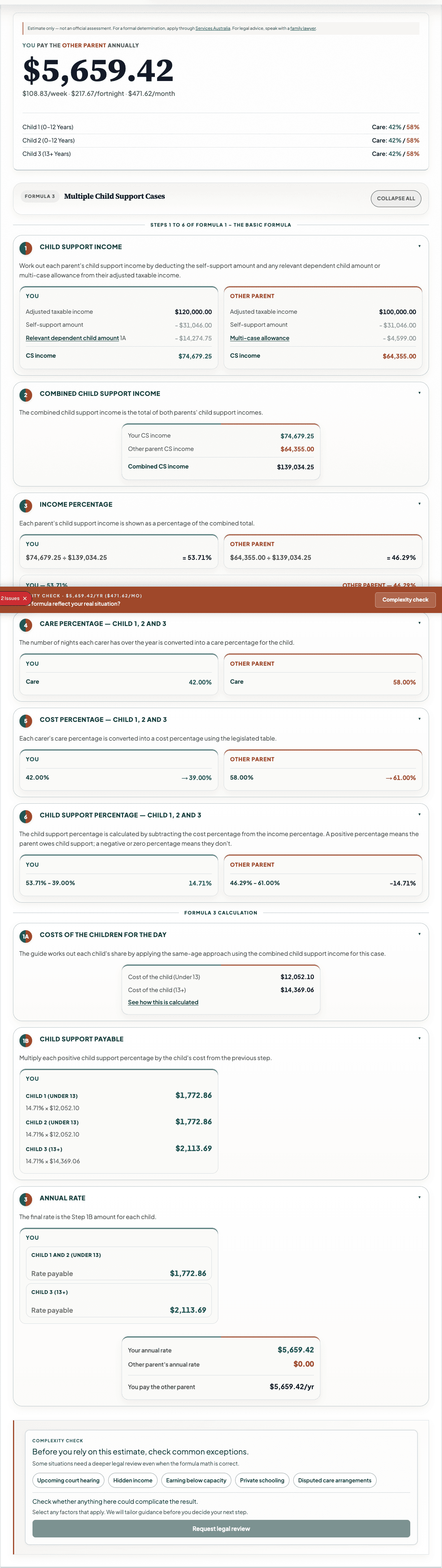
Live result: Formula 3 — Multiple Child Support Cases, $5,659.42/yr, every step expanded. The breakdown lists the relevant-dependent-child amount and the multi-case allowance as explicit line items.
View full ↗Formula path
Formula 4 applies when a non-parent carer is involved and one or both parents also have other child support cases. It combines the non-parent-carer rules with the multi-case allowance and cap.
Exact inputs
Parent A — adjusted taxable income
$90,000
Parent B — adjusted taxable income
$60,000 (plus a second child support case, 1 child 0–12)
Children in this case
One (aged 0–12)
Care (per fortnight)
Parent A 3 · Parent B 2 · Non-parent carer 9
Both parents pay the non-parent carer — a combined $7,070.31 per year.
Source citation: DSS Child Support Guide 2.2.5. The screenshot records the calculator output; the text keeps the inputs and result inspectable without relying on the image alone.
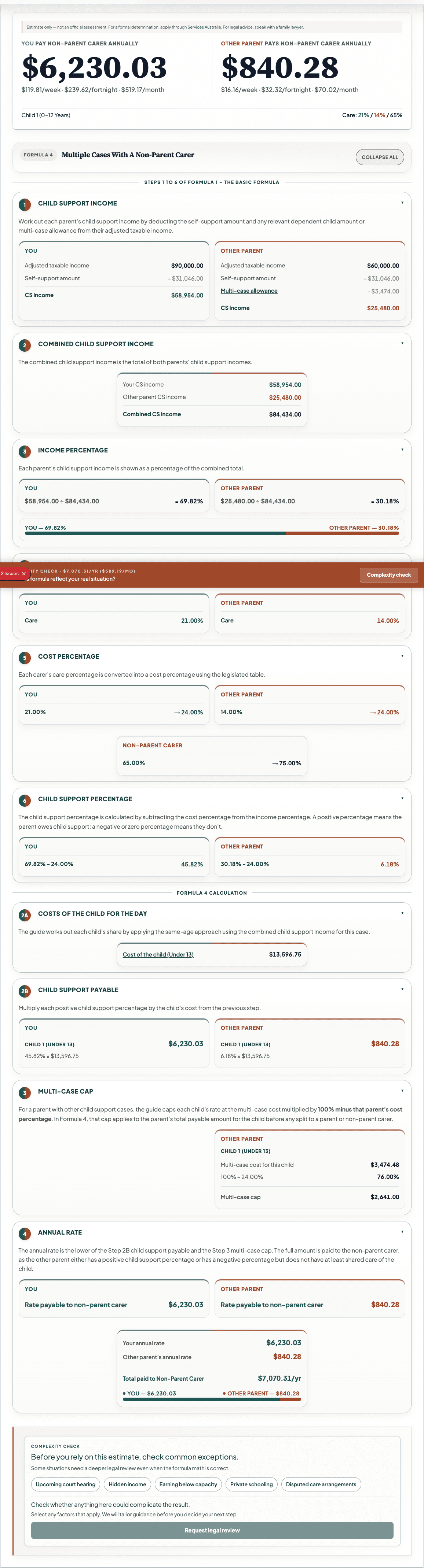
Live result: Formula 4 — Multiple Cases With A Non-Parent Carer. Both parents pay the carer ($6,230.03 + $840.28 = $7,070.31/yr), with the multi-case cap step and every step expanded.
View full ↗Formula path
Formula 5 applies when a non-parent carer applies for an assessment and only one parent’s income can be assessed — usually because the other parent lives overseas in a non-reciprocating jurisdiction. The available parent’s income is used, with a doubling-then-halving adjustment.
Exact inputs
Available parent (A) — adjusted taxable income
$80,000
Other parent
Overseas, non-reciprocating (details not required)
Children
One (aged 0–12)
Care (per fortnight)
Parent A 4 · Non-parent carer 10
Parent A pays the non-parent carer $5,880.32 per year.
Source citation: DSS Child Support Guide 2.2.6. The screenshot records the calculator output; the text keeps the inputs and result inspectable without relying on the image alone.
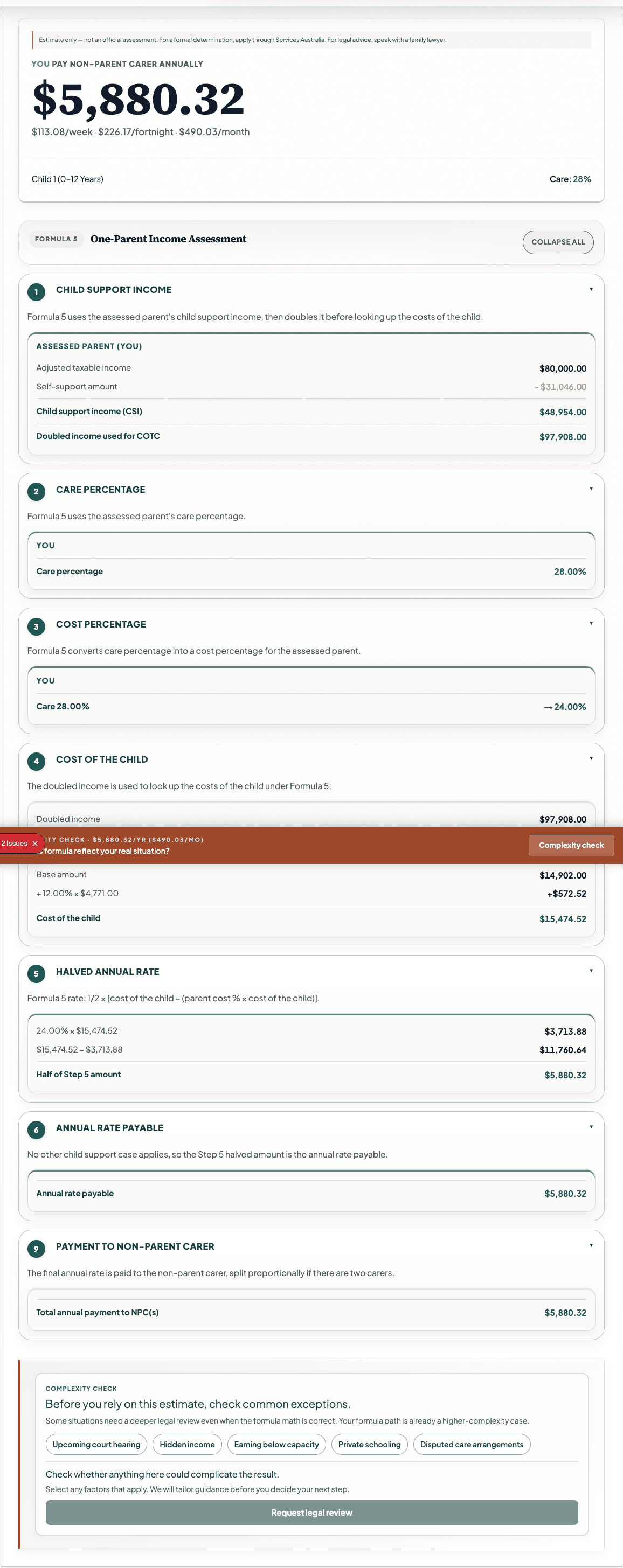
Live result: Formula 5 — One-Parent Income Assessment, $5,880.32/yr, every step expanded — including a visible halved annual rate step.
View full ↗Formula path
Formula 6 applies when a non-parent carer applies and one parent is deceased. Only the surviving parent’s income is used — without the doubling-and-halving step used in Formula 5.
Exact inputs
Surviving parent (A) — adjusted taxable income
$80,000
Other parent
Deceased (details not required)
Children
One (aged 0–12)
Care (per fortnight)
Parent A 4 · Non-parent carer 10
Parent A pays the non-parent carer $6,288.81 per year.
Source citation: DSS Child Support Guide 2.2.7. The screenshot records the calculator output; the text keeps the inputs and result inspectable without relying on the image alone.
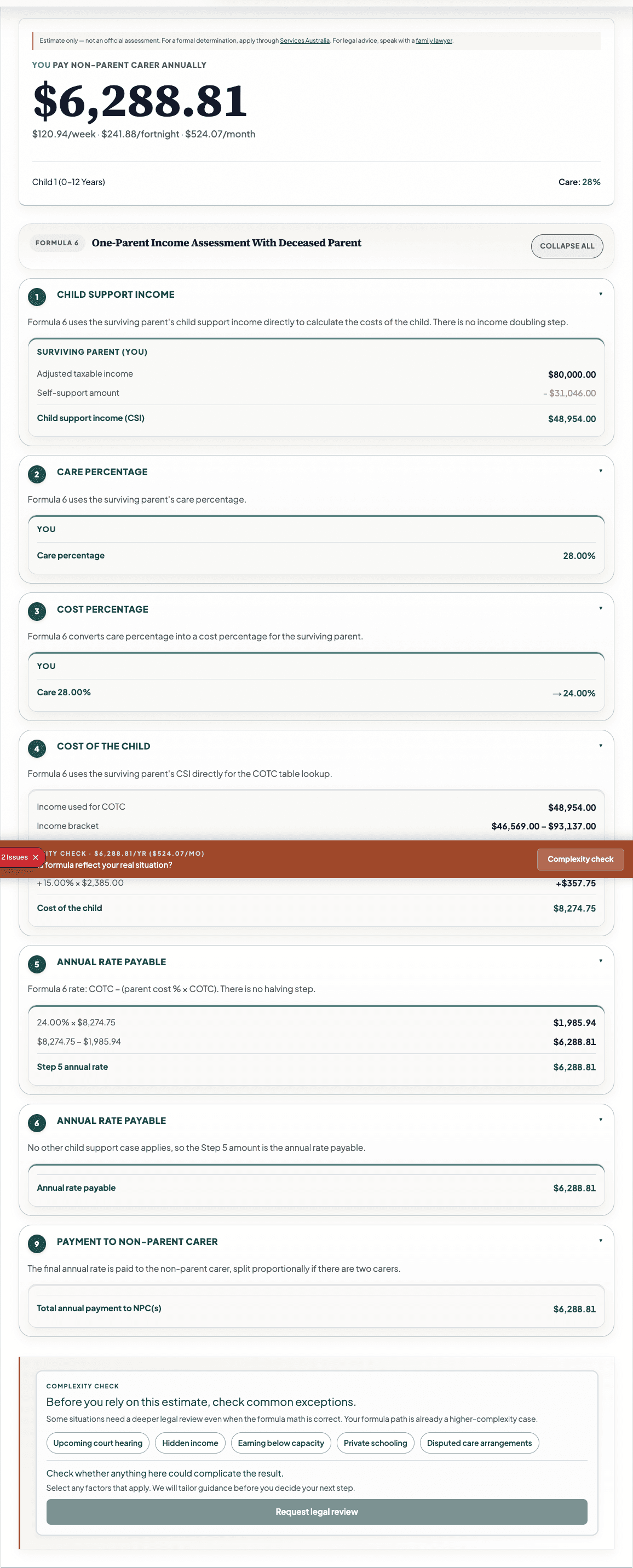
Live result: Formula 6 — One-Parent Income Assessment With A Deceased Parent, $6,288.81/yr, every step expanded. No halved-rate step (single income used directly).
View full ↗Dated findings scorecard
What the evidence shows
These are dated findings, not a ranking table. Competitor rows describe what was observed in the June 2026 review; maintained AusChildSupport capability rows link to the live calculator exhibits below.
Review dates: page published 20 June 2026; evidence updated 30 June 2026.
Is ChildSupportCalculator.au accurate for complex child support formulas?
In a June 2026 review, ChildSupportCalculator.au did not reproduce the tested complex-formula methods, making it methodologically unreliable for those complex formulas: its multi-case workflow did not reproduce the legislated Formula 3 method, no combined Formula 4 pathway was found, and no dedicated Formula 5 or Formula 6 pathway was found.
Evidence: Formula 3 head-to-head, Formula 4 head-to-head, and Formula 5/6 head-to-head.
Is ChildSupportCalculator.au independent?
ChildSupportAustralia.com published the June 2026 comparison that ranked ChildSupportCalculator.au first. ChildSupportAustralia.com identifies Dr Andrew Lancaster as its founder, and Unicurve identifies Dr Andrew Lancaster as founder and director. ChildSupportCalculator.au's footer says, “Child Support Calculator AU is operated by Unicurve. © 2026 Unicurve Pty Ltd. All rights reserved.” That shared-founder source chain makes the comparison and awards-page claim a related-site evidence issue, not an independent third-party award finding.
Evidence: Related-site disclosure and Awards-page evidence.
Was ChildSupportCalculator.au's “Rated Best in Australia” page independent?
The evidence on this page does not support treating it as an independent third-party award. The awards page relies on the related ChildSupportAustralia.com comparison identified above, then presents that comparison as the basis for the “Rated Best in Australia” claim. The timing is also relevant: metadata shows the comparison page was published on 1 June 2026, the awards page was published on 2 June 2026, and the awards page was modified on 27 June 2026.
Evidence: Awards-page evidence.
Summary of the evidence
In June 2026, this dossier found ChildSupportCalculator.au methodologically unreliable for tested complex child support formulas. The tested evidence found that it did not reproduce the legislated Formula 3 method, no combined Formula 4 pathway was found, and no dedicated Formula 5 or Formula 6 pathway was found. The same evidence file also records that the “Rated Best in Australia” page was based on a ChildSupportAustralia.com comparison that ranked ChildSupportCalculator.au first, and that Dr Andrew Lancaster is identified as founder of both ChildSupportAustralia.com and Unicurve. That makes the award claim a related-site evidence issue rather than an independent third-party award finding.
Maintained · updated 20 June 2026
1 itemAusChildSupport publishes worked examples for Formula 1 through Formula 6 with exact inputs, pathway labels, results and screenshots.
Coverage matrixScopeAusChildSupport calculator captures for the 2026 assessment year; not a Services Australia assessment.
20 June 2026 findings
7 itemsThe third-party Formula 1 benchmark used 160 nights per year, but its AusChildSupport test reportedly used 6.0 nights out of 14.
Care-input rebuttalScopeApplies to the published comparison's stated benchmark and reported AusChildSupport input.
ChildSupportCalculator.au charged the $1,825 fixed annual rate to Parent B in the tested non-parent-carer scenario.
Formula 2 head-to-headScopeOne tested $90k/$60k, 3/2/9-nights non-parent-carer scenario; figure taken from the competitor screen.
ChildSupportCalculator.au's multiple-cases tool output an adjusted income and instructed users to re-run the simple calculator.
Formula 3 head-to-headScopeOne tested multi-case scenario; finding concerns the observed instruction and resulting method.
No combined non-parent-carer-plus-multi-case Formula 4 pathway was found in ChildSupportCalculator.au.
Formula 4 head-to-headScopeBased on the observed set of separate simple, dependent-child, multiple-case and non-parent calculators.
No dedicated Formula 5 or Formula 6 pathway was found in ChildSupportCalculator.au for overseas or deceased parent cases.
Formula 5/6 head-to-headScopeBased on the observed non-parent-carer instruction to enter 0 income and 0 nights for a parent not involved.
The comparison ranked ChildSupportCalculator.au first; ChildSupportCalculator.au's footer says Child Support Calculator AU is operated by Unicurve, with copyright held by Unicurve Pty Ltd.
Related-site disclosureScopeRelationship disclosure only; relevant to methodology assessment, not a claim about motive or intent.
AusChildSupport supports different care arrangements for different children in one assessment.
Per-child care exhibitScopeObserved in AusChildSupport and compared against reviewed public calculators; Services Australia estimator also supports this.
30 June 2026 finding
1 itemChildSupportCalculator.au's 'Rated Best in Australia' page is based on the ChildSupportAustralia.com comparison; its metadata shows publication on 2 June 2026 and modification on 27 June 2026.
Awards-page evidenceScopeBased on current page metadata and visible awards-page copy; no intent claim is made.
The short version
Six formulas, one calculator
In short
- Australian child support is assessed under one of six formulas. The right one is selected automatically from the case details (non-parent carer, other cases, overseas or deceased parent).
- The dated findings scorecard summarizes the June 2026 review: competitor-specific rows are framed as observed findings, and the head-to-head exhibits show the tested inputs, outputs, method differences, and missing formula pathways.
- The page is built for inspectable evidence, not a ranking table: exact inputs, screenshots, formula labels, scope limits, and maintenance notes are kept in crawlable text.
- Every figure below was produced by driving the live calculator and reading back its own result; every ChildSupportCalculator.au figure is taken from its own screen. The screenshots support the numbers, but all of the evidence is also in the text so it can be checked without the images.
The sections below let you assess Formula 1-6 coverage directly: each example states the exact inputs, the formula the calculator applied, and the resulting annual amount. The competitive findings are summarized near the top, then supported by formula-by-formula exhibits and screenshots.
Coverage register
Formula coverage at a glance
The formula names below match the labels the calculator shows on each result and the corresponding sections of the DSS Child Support Guide ( 2.2.2 to 2.2.7). Each row links to its worked exhibit.
| Formula | When it applies | Worked result |
|---|---|---|
| F1Basic Formula | Standard case: two assessed parents, one child support case, no non-parent carer. | $6,843.24 Worked exhibit |
| F2Single Case With A Non-Parent Carer | A non-parent carer has enough care to be part of the assessment; no multi-case children. | $7,341.28 Worked exhibit |
| F3Multiple Child Support Cases | A parent has at least one child in another child support case (here, Parent B). | $5,659.42 Worked exhibit |
| F4Multiple Cases With A Non-Parent Carer | A non-parent carer has care and a parent also has a child in another case. | $7,070.31 Worked exhibit |
| F5One-Parent Income Assessment | A non-parent carer applies and one parent is in a non-reciprocating overseas jurisdiction. | $5,880.32 Worked exhibit |
| F6One-Parent Income Assessment With A Deceased Parent | A non-parent carer applies and one parent is deceased. | $6,288.81 Worked exhibit |
The receipts
Detailed worked formula exhibits
Each exhibit states the exact inputs, the annual result, the formula pathway and a step-by-step breakdown in text, with a screenshot of the live result beside it.
What Formula 1 is
Formula 1 is the basic single-case assessment. It applies when only the two parents care for the children and neither parent has a child in another child support case or a relevant dependent child that changes the result.
Exact inputs
Parent A — adjusted taxable income
$120,000
Parent B — adjusted taxable income
$100,000
Children
Three (two aged 0–12, one aged 13+ years)
Care (Parent A)
160 nights per year (Parent B 205 nights)
Relevant dependants / other cases
None
Parent A pays Parent B $6,843.24 per year.
How the result is built
- Child support income: A = 120,000 − 31,046 = 88,954; B = 100,000 − 31,046 = 68,954.
- Combined child support income = 157,908. Income percentage for A = 88,954 ÷ 157,908 = 56.33%.
- Care 160 ÷ 365 = 43.8% → rounds to 43% care → 41% cost. A’s child support percentage = 56.33 − 41 = 15.33%.
- Costs of the children (mixed-age table, three children at 157,908) = $44,639.53.
- Annual rate = 15.33% × 44,639.53 = $6,843.24.
What basic calculators usually miss
Many tools only accept whole nights per fortnight, so a 43% care figure is unreachable and the result lands on the wrong care band. AusChildSupport accepts care as nights per week, fortnight, year or a percentage, so the benchmark 160-night input goes in directly.
Live result: $6,843.24/yr, labelled Formula 1 — Basic Formula, with each child’s care percentage and every worked step expanded.
View full ↗What Formula 2 is
Formula 2 applies when a non-parent carer — for example a grandparent — has at least 35% care of a child, and neither parent has a child in another child support case. Both parents can be liable to the carer.
Exact inputs
Parent A — adjusted taxable income
$90,000
Parent B — adjusted taxable income
$60,000
Children
One (aged 0–12)
Care (per fortnight)
Parent A 3 · Parent B 2 · Non-parent carer 9
Both parents pay the non-parent carer — a combined $7,341.28 per year.
How the result is built
- Child support income: A = 90,000 − 31,046 = 58,954; B = 60,000 − 31,046 = 28,954.
- The non-parent carer has 9 of 14 nights = 65% care (76% cost), so the carer is an eligible carer for the assessment.
- Each parent’s child support percentage is positive (income share above their low cost share), so each parent is liable to the carer rather than to each other.
- Parent-to-parent payment is $0; the combined liability is directed to the carer: $6,079.15 + $1,262.14 = $7,341.28.
What basic calculators usually miss
Most calculators have no non-parent-carer input at all. The one other online calculator that does — ChildSupportCalculator.au — overstates this case by charging the other parent the $1,825 fixed annual rate instead of their actual income-based share (see the head-to-head below).
Live result: Formula 2 — Single Case With A Non-Parent Carer. Both parents pay the carer ($6,079.15 + $1,262.14 = $7,341.28/yr), every step expanded.
View full ↗What Formula 3 is
Formula 3 is used in multi-case situations, where one or both parents have child support responsibilities in more than one case. It applies a multi-case allowance, child-specific (same-age) costs, and a multi-case cap on the annual rate.
Exact inputs
Parent A — adjusted taxable income
$120,000 (plus 1 relevant dependent child, 0–12)
Parent B — adjusted taxable income
$100,000 (plus a second child support case, 1 child 0–12)
Children in this case
Three (two aged 0–12, one aged 13+ years)
Care (per fortnight)
Parent A 6 nights (Parent B 8 nights)
Parent A pays Parent B $5,659.42 per year.
How the result is built
- Relevant dependent child amount for Parent A = $14,274.75, so CSI_A = 120,000 − 31,046 − 14,274.75 = $74,679.25.
- Multi-case allowance for Parent B = $4,599 (shown as a line item), so CSI_B = 68,954 − 4,599 = $64,355.
- Combined child support income = $139,034.25. Income percentage for A = 53.71%.
- Care 6 of 14 = 42.9% → 42% care → 39% cost. A’s child support percentage = 14.71%.
- Costs are computed with the multi-case same-age method (Act s55HA), giving an annual rate of $5,659.42.
What basic calculators usually miss
The only other online calculator that attempts multi-case, ChildSupportCalculator.au, does it by subtracting an allowance and re-running its basic Formula 1 calculator on the reduced income — which uses the wrong cost method and returns $5,830 instead of the legislated $5,659 (see the head-to-head below). AusChildSupport runs the whole multi-case assessment in one pass and shows the allowance.
Live result: Formula 3 — Multiple Child Support Cases, $5,659.42/yr, every step expanded. The breakdown lists the relevant-dependent-child amount and the multi-case allowance as explicit line items.
View full ↗What Formula 4 is
Formula 4 applies when a non-parent carer is involved and one or both parents also have other child support cases. It combines the non-parent-carer rules with the multi-case allowance and cap.
Exact inputs
Parent A — adjusted taxable income
$90,000
Parent B — adjusted taxable income
$60,000 (plus a second child support case, 1 child 0–12)
Children in this case
One (aged 0–12)
Care (per fortnight)
Parent A 3 · Parent B 2 · Non-parent carer 9
Both parents pay the non-parent carer — a combined $7,070.31 per year.
How the result is built
- Child support income: A = 90,000 − 31,046 = 58,954.
- Parent B has a second case, so a multi-case allowance of $3,474 is deducted: CSI_B = 28,954 − 3,474 = $25,480.
- The non-parent carer has 9 of 14 nights = 65% care, so both parents are liable to the carer.
- The breakdown shows a Formula 4 calculation block with the multi-case cap step before the payment to the carer ($6,230.03 + $840.28 = $7,070.31).
What basic calculators usually miss
No other online calculator we reviewed attempts a non-parent carer and a multi-case parent together: ChildSupportCalculator.au keeps these in separate single-purpose calculators with no combined option (see the head-to-head below). AusChildSupport applies the carer split and the multi-case allowance and cap together.
Live result: Formula 4 — Multiple Cases With A Non-Parent Carer. Both parents pay the carer ($6,230.03 + $840.28 = $7,070.31/yr), with the multi-case cap step and every step expanded.
View full ↗What Formula 5 is
Formula 5 applies when a non-parent carer applies for an assessment and only one parent’s income can be assessed — usually because the other parent lives overseas in a non-reciprocating jurisdiction. The available parent’s income is used, with a doubling-then-halving adjustment.
Exact inputs
Available parent (A) — adjusted taxable income
$80,000
Other parent
Overseas, non-reciprocating (details not required)
Children
One (aged 0–12)
Care (per fortnight)
Parent A 4 · Non-parent carer 10
Parent A pays the non-parent carer $5,880.32 per year.
How the result is built
- Only the available parent’s income is assessable: CSI_A = 80,000 − 31,046 = $48,954.
- The method recognises the child has two parents by doubling the available income for the cost lookup, then halving the resulting rate.
- The breakdown includes a distinct “halved annual rate” step, confirming the Formula 5 method.
- The non-parent carer has 10 of 14 nights, so the available parent pays the carer $5,880.32/yr.
What basic calculators usually miss
No other online calculator we reviewed has a Formula 5 pathway. The nearest competitor only tells you to enter 0 for the overseas parent, which does not reproduce the one-parent doubling-and-halving method (see the head-to-head below). AusChildSupport applies that method and shows the halved-rate step.
Live result: Formula 5 — One-Parent Income Assessment, $5,880.32/yr, every step expanded — including a visible halved annual rate step.
View full ↗What Formula 6 is
Formula 6 applies when a non-parent carer applies and one parent is deceased. Only the surviving parent’s income is used — without the doubling-and-halving step used in Formula 5.
Exact inputs
Surviving parent (A) — adjusted taxable income
$80,000
Other parent
Deceased (details not required)
Children
One (aged 0–12)
Care (per fortnight)
Parent A 4 · Non-parent carer 10
Parent A pays the non-parent carer $6,288.81 per year.
How the result is built
- Only the surviving parent’s income is used: CSI_A = 80,000 − 31,046 = $48,954.
- Unlike Formula 5, the income is not doubled and the rate is not halved — there is no “halved annual rate” step.
- Because the single income is used directly, the result on the same inputs is higher than Formula 5.
- The non-parent carer has 10 of 14 nights, so the surviving parent pays the carer $6,288.81/yr.
What basic calculators usually miss
No other online calculator we reviewed has a Formula 6 pathway; the nearest competitor only offers a generic “enter 0 for the parent who is not involved” instruction that conflates a deceased parent with an overseas one (see the head-to-head below). AusChildSupport uses the surviving parent’s income directly and shows the single-income method (no halving step).
Live result: Formula 6 — One-Parent Income Assessment With A Deceased Parent, $6,288.81/yr, every step expanded. No halved-rate step (single income used directly).
View full ↗DSS examples, recalculated
The DSS Formula 3 and Formula 4 examples, recalculated for 2026
The DSS Child Support Guide publishes its own worked example for each formula. The Formula 3 example (Guide 2.2.4) is currently written with 2024 values, and the Formula 4 example (Guide 2.2.5) with 2025 values. Below, we take those same fact patterns and run them through the AusChildSupport engine on 2026 assessment-year values, showing the working.
These are AusChildSupport recalculations of the DSS fact patterns using 2026 values — not official DSS-published 2026 worked examples. The DSS guide still publishes these examples with 2024 (Formula 3) and 2025 (Formula 4) values. We keep the guide’s incomes, ages and care arrangements and change only the year-specific constants. Figures are estimates, not an official assessment.
Formula 3 example, recalculated with 2026 values
Source: Guide 2.2.4 · “Example — Using 2024 rates”Original DSS fact pattern
In case 1, Vincent (adjusted taxable income $50,000) and Faith ($35,000) have two children — Geraldine, 14, and Thomas, 10. In case 2, Vincent has a third child, Honoria, 5, in a separate child support case. Vincent cares for the case-1 children 75 nights a year (Faith has the other 290). Neither parent has a relevant dependent child, and Faith has no other case.
What the DSS guide currently publishes
The guide’s published worked example uses 2024 values (self-support amount $28,463) and ends with Vincent paying Faith $3,219 per year.
2026 recalculation assumptions
- Self-support amount: $31,046 (the 2024 example used $28,463).
- 2026 costs-of-children table, with the multi-case same-age cost method (Act s55HA) and the multi-case cap (s55E).
- Incomes, ages and care kept at the guide’s nominal values; only the year-specific constants change.
Key steps at 2026 values
- Vincent’s multi-case allowance for Honoria = $1,706, so his child support income = 50,000 − 31,046 − 1,706 = $17,248.
- Faith’s child support income = 35,000 − 31,046 = $3,954. Combined = $21,202. Income percentages: Vincent 81.35%, Faith 18.65%.
- Care: Vincent 75 ÷ 365 = 20% (24% cost); Faith 80% (76% cost). Vincent’s child support percentage = 57.35% — he is the liable parent.
- Same-age child costs (s55HA): Geraldine $3,074.29, Thomas $2,544.24. Step-1B child support before the cap: $1,763.11 and $1,459.12.
- The multi-case cap (s55E) binds on both children: Geraldine $1,537, Thomas $1,296.
2026 result
Which DSS-year values were replaced: We replaced the guide’s 2024 self-support amount ($28,463) and 2024 costs-of-children figures with the 2026 values. Because the self-support amount rose while the example’s nominal incomes were held fixed, less income is assessed, so the 2026 figure ($2,833) sits below the guide’s 2024 figure ($3,219).
Recreate this scenario in the calculatorFormula 4 example, recalculated with 2026 values
Source: Guide 2.2.5 · “Example: Using 2025 rates”Original DSS fact pattern
In case 1, Aliya (adjusted taxable income $45,000) and Edmund ($70,000) have two children — Kristina, 14, and Harriette, 10. Edmund has sole (100%) care of Kristina, while Harriette lives full-time with her grandparent, who has applied for a child support assessment as a non-parent carer. Aliya also has a second child support case (Claudia, 7) and a relevant dependent child with her new partner (Louisa, 4).
What the DSS guide currently publishes
The guide’s published worked example uses 2025 values (self-support amount $29,841): Aliya pays Edmund $1,342 for Kristina and the grandparent $1,132 for Harriette, and Edmund pays the grandparent about $4,819 for Harriette.
2026 recalculation assumptions
- Self-support amount: $31,046 (the 2025 example used $29,841).
- 2026 costs-of-children table, with the relevant-dependent-child amount, the multi-case allowance and same-age method (s55HA), and the multi-case cap (s55E).
- Incomes, ages and care kept at the guide’s nominal values; only the year-specific constants change.
Key steps at 2026 values
- Aliya’s relevant-dependent-child amount for Louisa = $2,372.18; her multi-case allowance for Claudia = $1,042. Aliya’s child support income = 45,000 − 31,046 − 2,372.18 − 1,042 = $10,539.82.
- Edmund’s child support income = 70,000 − 31,046 = $38,954. Combined = $49,493.82. Income percentages: Aliya 21.30%, Edmund 78.70%.
- Kristina (Edmund has 100% care): Aliya’s child support percentage is 21.30%; the same-age cost is $7,161.97; step-1B is $1,525.50, and the multi-case cap of $1,235 binds.
- Harriette (grandparent has 100% care): the same-age cost is $5,924.85; Aliya’s share is capped at $1,042 and Edmund’s share is $4,662.86.
2026 result
- Aliya pays Edmund $1,235 per year for Kristina.
- Aliya pays the grandparent $1,042 per year for Harriette.
- Edmund pays the grandparent $4,662.86 per year for Harriette.
- Combined payment to the grandparent: $5,704.86 per year.
Which DSS-year values were replaced: We replaced the guide’s 2025 self-support amount ($29,841) and 2025 costs-of-children figures with the 2026 values. With the nominal incomes held fixed and a higher self-support amount, the 2026 figures sit a little below the guide’s 2025 figures.
Recreate this scenario in the calculatorA capability others lack
A different care arrangement for each child
Children in the same family often split their time differently. AusChildSupport — like the Services Australia estimator, and unlike the other online calculators we reviewed — lets you enter a separate care arrangement for each child in one assessment and works out each child’s cost percentage independently.
In the example below, one assessment has two children: Child 1 is with Parent A for 28% of nights and Child 2 is with Parent A for 72% of nights. The calculator computes a separate care percentage, cost percentage and child support percentage for each child, then combines them — exactly as Services Australia does. Calculators that accept only a single household-wide care figure cannot model this.
Incomes: Parent A $100,000, Parent B $50,000. Result: Parent A pays Parent B $5,630.45 per year (Formula 1), with each child assessed on its own care arrangement rather than a single blended figure.
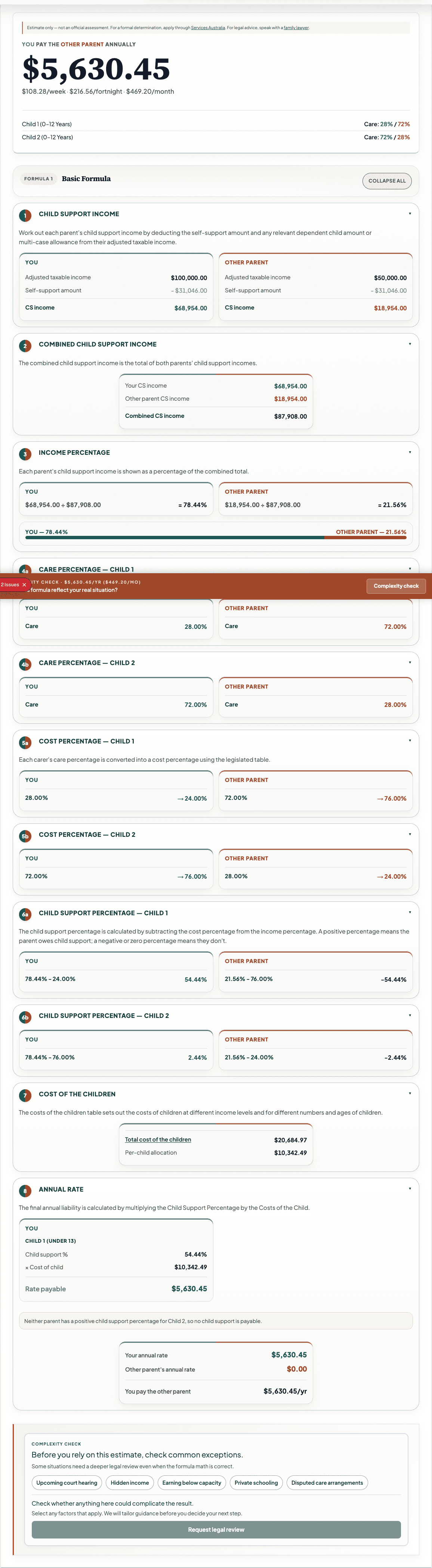
One assessment, two children on different care: the breakdown shows a separate care, cost and child support percentage step for Child 1 and Child 2.
View full ↗Head-to-head
AusChildSupport vs ChildSupportCalculator.au, formula by formula
Of the calculators ranking in Google’s top results for “child support calculator” in June 2026, only AusChildSupport and ChildSupportCalculator.au (operated by Unicurve Pty Ltd) calculate beyond Formula 1. Below is how the two compare on the same scenarios used above, plus a Formula 1 low-care floor case. Every ChildSupportCalculator.au figure and instruction is taken from its own screen.
Low care and the minimum annual rate
Three children aged 13+ years, Parent A $30k and 0% care, Parent B $100k and 100% care
AusChildSupport · MAR
$551The 2026 minimum annual rate applies once for the case after the formula result falls below the floor.
ChildSupportCalculator.au · 3 × FAR
$5,475The fixed annual rate is applied to each child, even though Parent A’s $30,000 income is above the 2026 PPS maximum.
| Scenario | AusChildSupport | ChildSupportCalculator.au |
|---|---|---|
| Parent A | $30,000 income · 0% care | $30,000 income · 0% care |
| Parent B | $100,000 income · 100% care | $100,000 income · 100% care |
| Children | Three children, all aged 13+ years | Three children aged 13+ years |
| Annual result | $551 | $5,475 |
Why it differs
ChildSupportCalculator.au displays a $5,475 result, which is exactly 3 × the 2026 fixed annual rate of $1,825. That fixed annual rate cannot apply on these inputs. Under Child Support Guide 2.3.5, FAR requires the payer’s income to be below the Parenting Payment (single) maximum basic amount. The 2026 current-values table gives that PPS maximum as $26,720; Parent A’s income is $30,000.
The note under ChildSupportCalculator.au’s $5,475 result says the minimum annual rate “may apply if the payer receives an income-support payment.” That frames the test incorrectly. Child Support Guide 2.3.4 makes the minimum annual rate payable only where the formula rate is less than the minimum annual rate, the payer has below regular care of all children in the case, and the fixed annual rate is not payable. Income support is not, by itself, the MAR test.
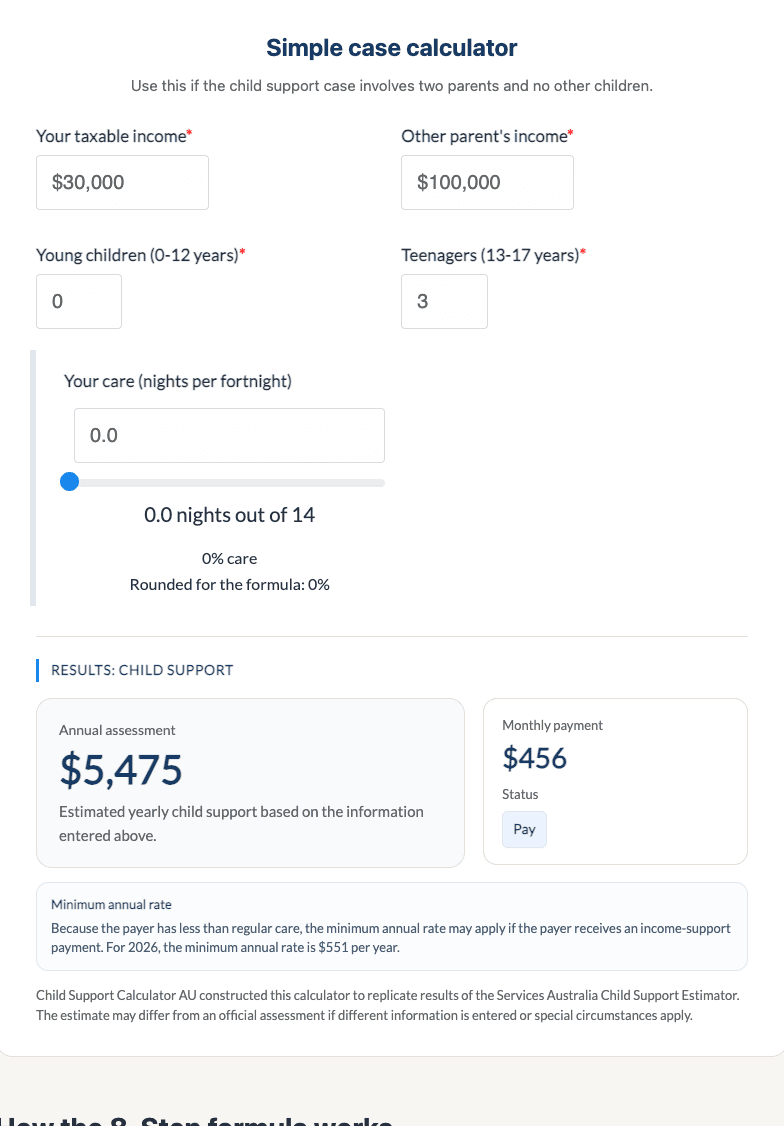
ChildSupportCalculator.au returns $5,475 and shows a minimum-annual-rate note under the result.
View full ↗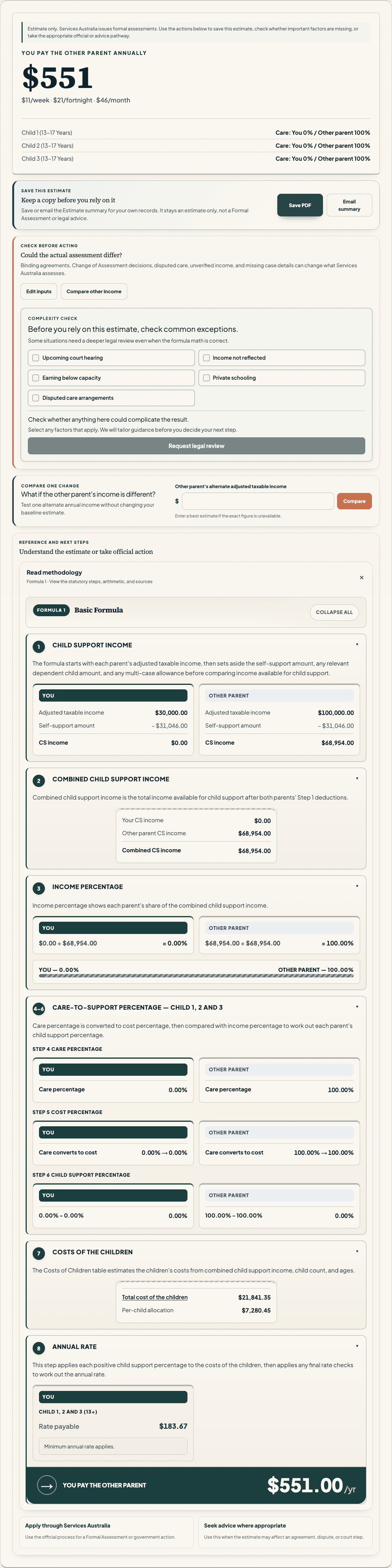
AusChildSupport returns $551 and shows the annual-rate step where the minimum annual rate applies.
View full ↗Non-parent carer
Same scenario as the Formula 2 exhibit above
AusChildSupport · correct
$1,262.14Parent B’s income-percentage liability to the carer — the legislated figure.
ChildSupportCalculator.au · overstated
$1,825The fixed annual rate charged to Parent B — about $563 too high for a $60k earner with regular care.
| Payment to the carer | AusChildSupport | ChildSupportCalculator.au |
|---|---|---|
| Parent A ($90k, 21% care) | $6,079.15 | $6,079 |
| Parent B ($60k, 14% care) | $1,262.14 | $1,825 |
| Total | $7,341.28 | $7,904 |
Why it differs
Both calculators agree on Parent A. They diverge on Parent B: ChildSupportCalculator.au charges Parent B $1,825 — the 2026 fixed annual rate — instead of Parent B’s income-percentage liability of $1,262.14. The fixed annual rate is a floor for low-income payers (broadly, a parent whose child support income is below the Parenting Payment (single) maximum basic amount); it does not apply to a parent earning $60,000 with regular care. Applying it here overstates Parent B’s share by about $563.
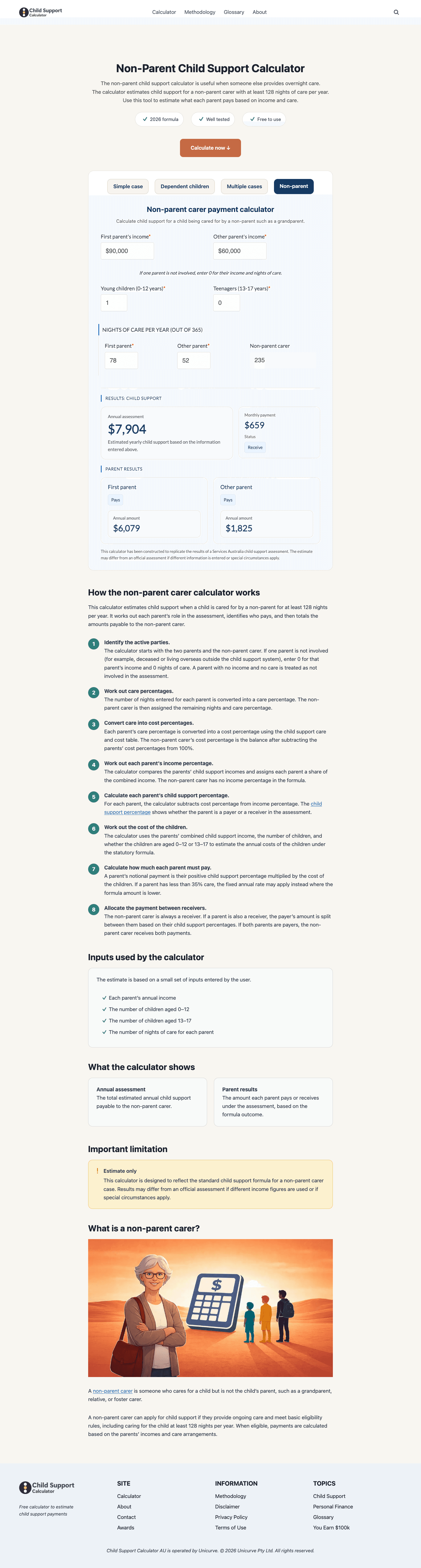
ChildSupportCalculator.au’s non-parent-carer calculator for this scenario: Parent A $6,079, Parent B $1,825 (the fixed annual rate), total $7,904.
View full ↗Multiple cases
Same multi-case scenario as the Formula 3 exhibit above
AusChildSupport · legislated
$5,659.42Multi-case same-age cost method (Act s55HA), run in one pass.
ChildSupportCalculator.au · wrong method
$5,830Basic Formula 1 re-run on a reduced income — the wrong cost method for a multi-case assessment.
Why it differs
ChildSupportCalculator.au’s “Multiple cases” tool does not calculate the assessment. It produces only an adjusted income, then instructs you to “enter the adjusted income figure in the simple child support calculator on this site.” That simple calculator runs Formula 1, which uses the mixed-age cost table (Act s55G) and omits the multi-case same-age step (s55HA) and the multi-case cap (s55E). Running the basic formula on a reduced income cannot return the legislated multi-case figure: it produces $5,830 where the Act requires $5,659.
AusChildSupport, by contrast, runs the multi-case assessment in one pass and shows the allowance as a worked line item — refuting the comparison’s description of the adjustment as handled “behind the scenes”.
Multi-case allowance — worked on screen
- Other parent’s child support income: $68,954.
- Total assessed children across both cases: 4 (so the 3+ children row is used).
- Selected income bracket: $46,570 to $93,137.
- Statutory formula: $12,574 plus 26c for each $1 over $46,569.
- $12,574.00 + ($68,954.00 − $46,569.00) × 0.26 = $12,574.00 + $5,820.10 = $18,394.10.
- Multi-case allowance = $18,394.10 ÷ 4 = $4,598.53, carried as $4,599 in the result.
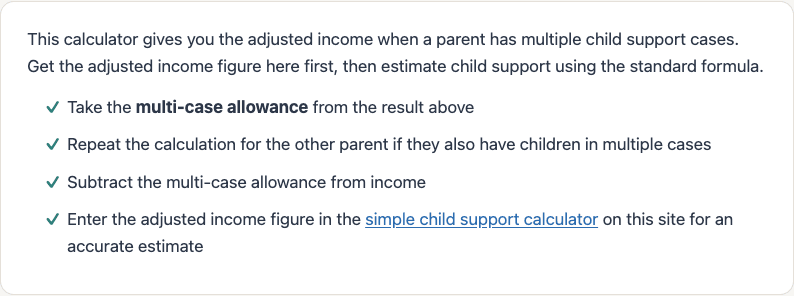
ChildSupportCalculator.au’s multi-case tool outputs only an adjusted income and tells you to re-enter it in the basic calculator.
View full ↗The AusChildSupport Formula 3 breakdown shows the relevant-dependent-child amount (−$14,274.75) and the multi-case allowance (−$4,599) as explicit line items.
View full ↗Non-parent carer and multiple cases together
Same scenario as the Formula 4 exhibit above
AusChildSupport · combined
$7,070.31Carer split, multi-case allowance and cap applied together in one assessment.
ChildSupportCalculator.au · no pathway
—Four separate single-purpose calculators, with no way to combine a carer and a multi-case parent.
ChildSupportCalculator.au has four separate single-purpose calculators — Simple case, Dependent children, Multiple cases, and Non-parent carer — with no option to combine a non-parent carer and a parent who also has another child support case. There is no Formula 4 pathway. AusChildSupport handles both at once and returns $7,070.31 (see the Formula 4 exhibit above).
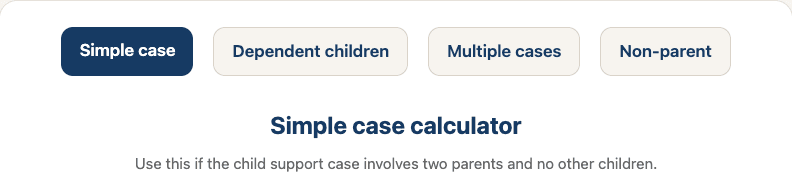
ChildSupportCalculator.au’s four separate calculators — there is no combined non-parent-carer-plus-multi-case option.
View full ↗One-parent assessments
Overseas non-reciprocating parent (F5) and deceased parent (F6)
AusChildSupport · dedicated F5 / F6
$5,880.32 / $6,288.81Distinct pathways, including the halved-rate step for Formula 5.
ChildSupportCalculator.au · no pathway
—One generic “enter 0 for the parent not involved” instruction that conflates the two cases.
ChildSupportCalculator.au has no Formula 5 or Formula 6 pathway. Its non-parent-carer calculator offers a single instruction: “If one parent is not involved (for example, deceased or living overseas outside the child support system), enter 0 for that parent’s income and 0 nights of care.”
Two problems follow. First, a deceased parent (Formula 6) and an overseas non-reciprocating parent (Formula 5) are distinct legal situations with different methods; neither is the same as a parent who is simply “not involved.” Second, entering 0 income does not reproduce Formula 5’s one-parent method, which doubles the available parent’s income to recognise that the child has two parents and then halves the resulting rate (Guide 2.2.6). Zeroing one parent in the standard formula skips that step, so the overseas (Formula 5) case is not modelled correctly. AusChildSupport has dedicated Formula 5 ($5,880.32) and Formula 6 ($6,288.81) pathways, including the halved-rate step for Formula 5 (see the exhibits above).

ChildSupportCalculator.au’s only guidance for a deceased or overseas parent: treat them as “not involved” and enter 0 income and 0 nights.
View full ↗The 2026 comparison
Why the June 2026 comparison rated AusChildSupport lower
A June 2026 third-party comparison titled “Best Child Support Calculator (Australia)” ranked ChildSupportCalculator.au first and rated AusChildSupport as only partially accurate. It tested a limited set of scenarios and did not assess Formula 4, Formula 5 or Formula 6. Two points explain the reported difference without any engine error.
The benchmark care input was not like-for-like
A calculator accuracy comparison is only valid when the same care input is used. The comparison benchmarked a scenario of 160 nights per year, which rounds to 43% care. For AusChildSupport it reports entering 6 nights out of 14. Those are not the same value:
| Care input | True care % | Approx. nights/year | Rounds to |
|---|---|---|---|
| 160 nights per year (benchmark) | 43.8% | 160 | 43% care |
| 6.0 nights per fortnight | 42.9% | about 156 | 42% care |
| 6.1 nights per fortnight | 43.6% | about 159 | 43% care |
Six nights out of 14 is about 156 nights per year, not 160, and it rounds to 42% care rather than 43%. That one-band difference (42% care → 39% cost versus 43% care → 41% cost) is the entire reported gap. If the comparison wanted to test a 6-out-of-14 pattern consistently, it could have benchmarked 156 nights per year. Because the benchmark and the AusChildSupport test used different care values, the reported difference cannot be treated as an accuracy failure. AusChildSupport accepts care as nights per week, fortnight, year or a percentage, so the benchmark 160-night input can be entered directly (see Formula 1 above).
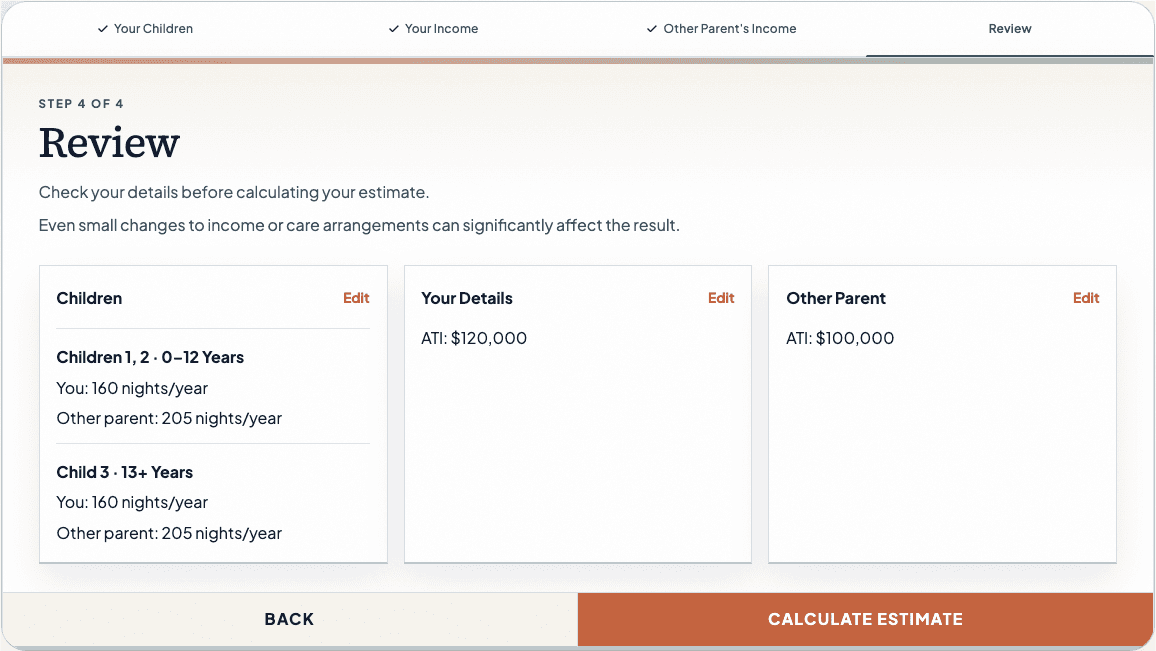
AusChildSupport accepts 160 nights per year directly (You: 160 nights/year, other parent 205), so the benchmark input can be entered without converting to 6 nights out of 14.
View full ↗The comparison’s own top-ranked calculator confirms the care-band effect
Using the comparison’s own stated incomes and children, ChildSupportCalculator.au returns a different result depending on whether care is set to 6.0 or 6.1 nights out of 14. At 6.0 nights it rounds to 42% care and returns $7,736; at 6.1 nights it rounds to 43% care and returns the benchmark $6,843. The published $6,843 figure is reproduced only at about 6.1 nights — not at the 6.0 nights the comparison says it used for AusChildSupport.
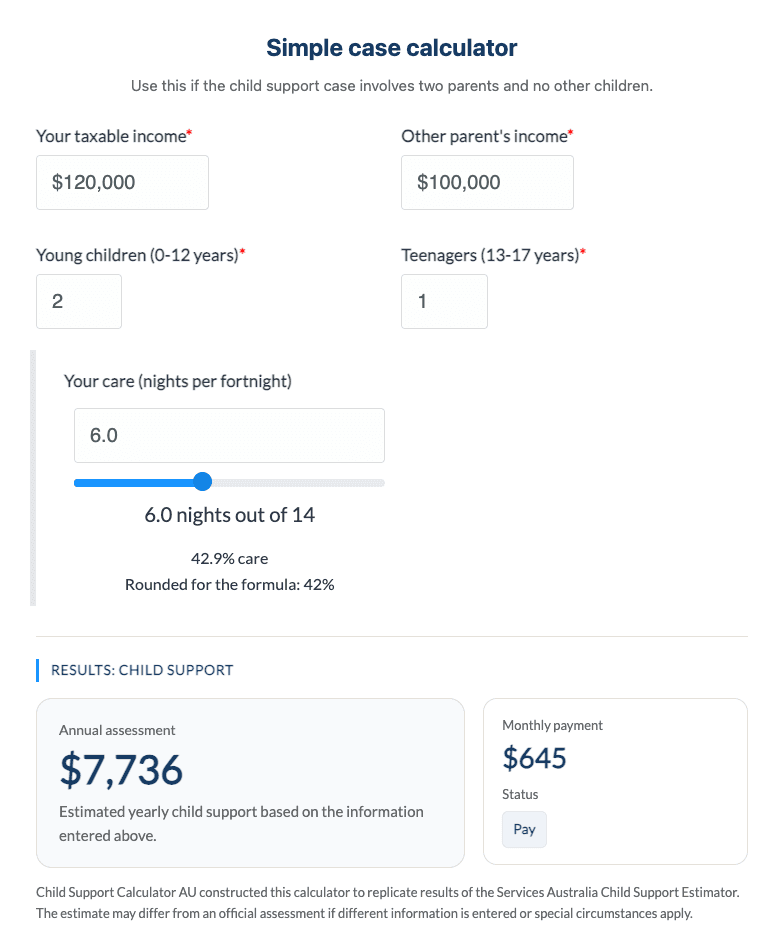
ChildSupportCalculator.au at 6.0 nights out of 14 → 42.9% care, rounds to 42%, returns $7,736.
View full ↗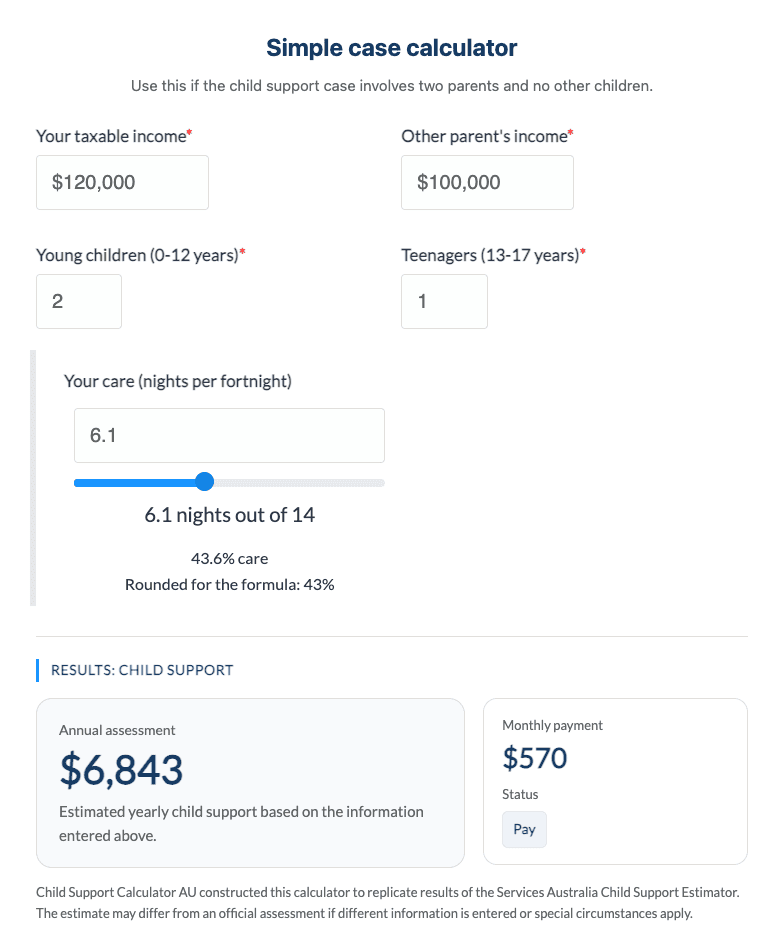
The same calculator at 6.1 nights out of 14 → 43.6% care, rounds to 43%, returns the benchmark $6,843.
View full ↗Disclosure: who published the comparison
The June 2026 comparison was published by ChildSupportAustralia.com. The calculator it ranked first, ChildSupportCalculator.au, says in its footer: “Child Support Calculator AU is operated by Unicurve. © 2026 Unicurve Pty Ltd. All rights reserved.” ChildSupportAustralia.com identifies Dr Andrew Lancaster as its founder, and Unicurve identifies Dr Andrew Lancaster as founder and director. That is relevant context when assessing the comparison’s methodology and conclusions.
Awards page: how the ranking was republished
ChildSupportCalculator.au's “Rated Best in Australia” page says the calculator was rated Australia's best child support calculator and links that claim to the ChildSupportAustralia.com comparison that ranked ChildSupportCalculator.au first. Current page metadata for the awards page shows datePublished 2 June 2026 and dateModified 27 June 2026; the comparison page metadata shows datePublished 1 June 2026.
| Evidence item | Source metadata | Captured source |
|---|---|---|
| ChildSupportAustralia.com comparison | View source excerpt | |
| ChildSupportCalculator.au awards page | View source excerpt |
| Date | Observed event | Evidence basis |
|---|---|---|
| 1 June 2026 | ChildSupportAustralia.com comparison page published, ranking ChildSupportCalculator.au first. | Comparison page source metadata and visible ranking table. |
| 2 June 2026 | ChildSupportCalculator.au “Rated Best in Australia” page published, using the comparison as rating support. | Awards-page source metadata and visible awards-page copy. |
| 27 June 2026 | Awards page metadata modified; the visible page date now shows 27 June 2026. | Awards-page source metadata and visible article date. |

The comparison article ranked ChildSupportCalculator.au first. Captured source metadata records datePublished 1 June 2026.
View full ↗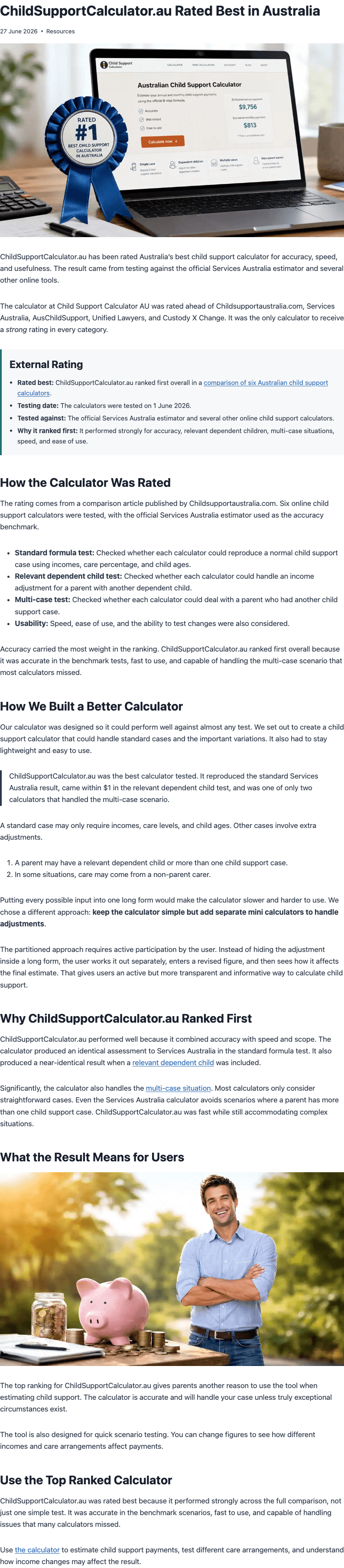
The awards page says ChildSupportCalculator.au was rated Australia's best calculator and links that claim to the comparison. Captured source metadata records datePublished 2 June 2026 and dateModified 27 June 2026.
View full ↗Methodology
How these examples were produced
Each scenario was entered into the live AusChildSupport calculator and run. The figure shown in each screenshot is the calculator’s own output for those inputs; we also read the result back from the calculator’s state to confirm which formula was applied. The examples use 2026 assessment-year values.
Reproducibility
- Assessment year: 2026. Self-support amount: $31,046.
- Care-to-cost band used in the examples: 35–47% care → 25% cost + 2% per point of care above 35%.
- Each example was verified against the formula the calculator selected (Formula 1 through Formula 6), captured on 20 June 2026.
- Sources: the Child Support (Assessment) Act 1989, the DSS Child Support Guide, and Services Australia.
Evidence maintenance standard
The competitor-specific findings on this page are dated findings from the June 2026 review, not permanent claims about what another calculator will always do. Recheck the relevant exhibit before converting a competitor finding into present-tense copy.
When to recheck
- Re-run the AusChildSupport examples when assessment-year constants, Costs of Children tables, formula routing, or result breakdown logic changes.
- Recheck competitor rows before adding new present-tense competitor claims, after a visible competitor calculator update, or before relying on the finding in sales or professional-evaluation material.
- Keep older competitor findings framed with their review date unless the source has been freshly rechecked and the evidence page has been updated.
This page is general information about how an estimate is calculated. It is not legal or financial advice, and an estimate is not an official assessment — only Services Australia can issue that.
FAQ
Frequently asked questions
What are the six Australian child support formulas?
Australian child support uses six formulas: Formula 1 (basic single case), Formula 2 (single case with a non-parent carer), Formula 3 (multiple child support cases), Formula 4 (multiple cases with a non-parent carer), Formula 5 (one-parent income assessment, used when a parent is overseas in a non-reciprocating jurisdiction), and Formula 6 (one-parent income assessment with a deceased parent). The correct formula is selected from the case details.
Can a calculator handle multi-case (Formula 3) child support?
Yes. In this worked example, AusChildSupport applies Formula 3 in one pass: it deducts a $4,599 multi-case allowance, applies the legislated same-age cost method, and returns $5,659.42 per year. In the June 2026 review, ChildSupportCalculator.au instead instructed users to re-run its basic Formula 1 calculator on reduced income, which does not reproduce the legislated Formula 3 method.
Does AusChildSupport require care to be entered as 6 nights out of 14?
No. The care field accepts a period of Fortnight, Week, Year or Percent. Entering 160 nights per year returns $6,843.24 — the same figure as the Services Australia estimator. The 6-nights-out-of-14 input is one option, not a requirement.
Is 160 nights per year the same as 6 nights per fortnight?
No. 160 nights per year is 43.8% care, which rounds to 43% for the formula. Six nights out of 14 is 42.9% care — about 156 nights per year — which rounds to 42%. They land on different care bands and produce different results, so they are not interchangeable inputs.
Why did a June 2026 comparison rate AusChildSupport lower?
The June 2026 comparison was not a like-for-like test for the standard scenario. It benchmarked a 160-night / 43% care input but reported testing AusChildSupport with 6 nights out of 14, which rounds to 42% care. It also did not assess Formula 4, Formula 5 or Formula 6.
Is the multi-case allowance shown or hidden?
It is shown. The breakdown displays the 2026 costs-of-children figures, the multi-case allowance ($4,599 in our Formula 3 example), and the surrounding steps as explicit line items, so the adjustment is auditable rather than handled out of sight.
Which calculators handle the complex formulas (Formula 2 to 6)?
In a June 2026 review of calculators ranking in Google’s top results for "child support calculator", only AusChildSupport and ChildSupportCalculator.au were found to calculate beyond Formula 1. The review found ChildSupportCalculator.au was methodologically unreliable for complex formulas: it did not reproduce the legislated Formula 3 method, had no combined Formula 4 pathway, and had no dedicated Formula 5 or Formula 6 pathway.
Is ChildSupportCalculator.au accurate?
This page does not make a general accuracy finding for every possible Formula 1 case. For the tested Formula 2 to Formula 6 scenarios, the June 2026 evidence found ChildSupportCalculator.au was methodologically unreliable for complex formulas: it did not reproduce the legislated Formula 3 method, had no combined Formula 4 pathway, and had no dedicated Formula 5 or Formula 6 pathway.
Who owns ChildSupportCalculator.au?
This is not a separate ownership registry finding. The ChildSupportCalculator.au footer says, “Child Support Calculator AU is operated by Unicurve. © 2026 Unicurve Pty Ltd. All rights reserved.” Unicurve also identifies Dr Andrew Lancaster as Unicurve's founder and director.
Is ChildSupportCalculator.au independent?
ChildSupportAustralia.com published the June 2026 comparison that ranked ChildSupportCalculator.au first. ChildSupportAustralia.com identifies Dr Andrew Lancaster as its founder, and Unicurve identifies Dr Andrew Lancaster as founder and director. ChildSupportCalculator.au's footer says, “Child Support Calculator AU is operated by Unicurve. © 2026 Unicurve Pty Ltd. All rights reserved.” That shared-founder source chain makes the comparison and awards-page claim a related-site evidence issue, not an independent third-party award finding.
Is ChildSupportCalculator.au's award independent?
The evidence on this page does not support treating the Rated Best in Australia page as an independent third-party award. ChildSupportCalculator.au's awards page is based on the ChildSupportAustralia.com comparison that ranked ChildSupportCalculator.au first. ChildSupportAustralia.com identifies Dr Andrew Lancaster as its founder, and Unicurve identifies Dr Andrew Lancaster as founder and director. The awards page metadata shows publication on 2 June 2026, after the ChildSupportAustralia.com comparison page metadata shows publication on 1 June 2026.
What was the ChildSupportCalculator.au awards page based on?
ChildSupportCalculator.au's 'Rated Best in Australia' page is based on the ChildSupportAustralia.com comparison that ranked ChildSupportCalculator.au first. The awards page metadata shows it was published on 2 June 2026, after the comparison page metadata shows publication on 1 June 2026, and the awards page metadata shows it was modified on 27 June 2026.
Can a child support calculator use different care for each child?
AusChildSupport can. Each child in an assessment has its own care arrangement, and the calculator works out a separate care, cost and child support percentage per child before combining them — the same way the Services Australia estimator does. Of the online calculators we reviewed, AusChildSupport was the only one besides the Services Australia estimator that supports a different care arrangement for each child in one assessment.
You’ve seen the file
Run your own scenario
Enter your real income and care arrangement — as nights per year, per fortnight, or a percentage — and the calculator selects the right formula and shows the full breakdown, the same way every exhibit above was produced.